November 2024
The Research & Insights Team
November 2024
The Research & Insights Team
The data is clear. Workplaces with an unassigned seating strategy and good variety of space offer, on average, the best employee experience. With hybrid working leaving space and desks unused for long periods, it’s no wonder that unassigned can be such an attractive option.
And yet. The key word is average: not everyone has a great experience in unassigned workplaces, even with a wide variety of spaces.
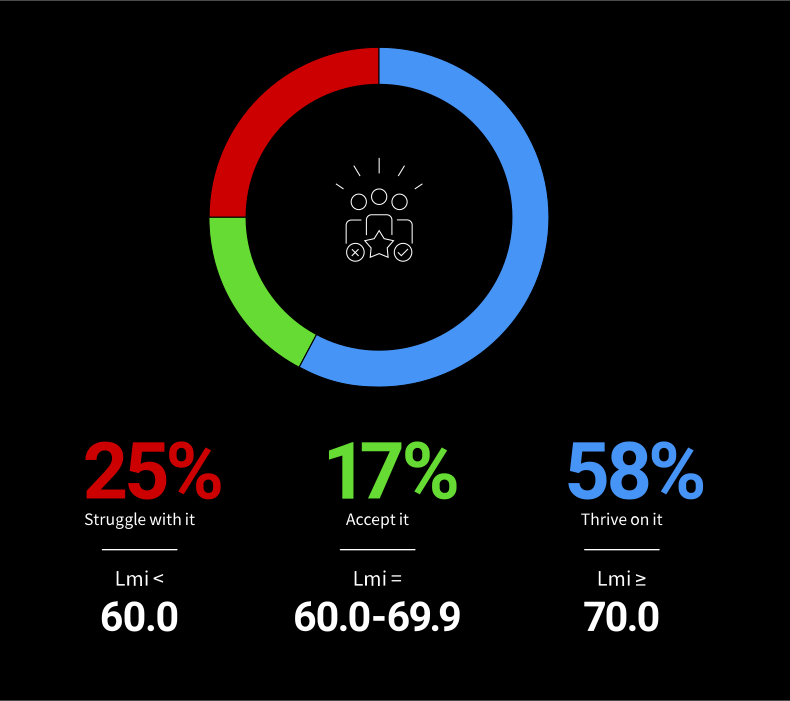
In our latest report, we surveyed employees working in workplaces with unassigned seating and good variety. A promising 58% are thriving: 20% have an excellent experience (with a Lmi between 70.0 and 79.9) and 38% an outstanding one (Lmi of 80.0+).
But nearly one in five employees seem to only accept this strategy, without necessarily making full use of its potential. In contrast to the Thrivers, these are the Accepters. Making up 17% of the sample, the Accepters have an Lmi between 60.0 and 69.9. Only two thirds of these employees think the environment enables them to work productively.
Even more worryingly, one in four employees (25%) are Strugglers. Dissatisfied with the unassigned approach, Strugglers have a poor experience, with a Lmi below 60.0. Just 26% say that the environment enables them to work productively – an alarmingly low figure.
Some of the differences are likely attributable to change management; the processes through which new solutions are delivered are crucial to achieving successful outcomes. Likewise, age and seniority play a significant role. But so too do shortcomings in workplace infrastructure.
Only by understanding the different needs and experiences of each group will you be able to maximise the number of employees who are thriving.
Importantly, these proportions can vary greatly from one workplace to another. Even within a single organisation, different workplaces with the same strategy might have significantly different shares of employees from each of the three experience groups. So, what do Thrivers, Accepters and Strugglers look like on average?
Thrivers, Accepters and Strugglers are spread across organisations. But our research clearly shows that certain demographics are more or less likely to thrive in an unassigned workplace with good variety.
Age is arguably the biggest factor. Among the youngest workplace users – those aged under 25 – 71% are Thrivers, and just 13% are Strugglers.
Yet as people age, so those percentages change; employees in the oldest age group, of 55 and over, have a smaller proportion of Thrivers (55%) and a far larger share of Strugglers (28%).
Likewise with seniority. Among people managers, 52% are Thrivers and 30% are Strugglers, while senior leaders have the smallest share of Thrivers (51%) and a higher number of Strugglers (33%). Running alongside that is length of tenure. People who have been with an organisation for six months or less include the biggest proportion of Thrivers (72%) and the smallest share of Strugglers (14%).
And just as with age, those proportions change over time. Only 53% of those with the longest tenure – 12 years or more – are Thrivers; 29% are Strugglers, twice the proportion we see among new hires. This could be that for many new starters, the workplace is likely one reason they accepted the job. New joiners also have a honeymoon period, where they see their workplace more positively compared to colleagues. On the other hand, older, more experienced and longer-serving employees may require more attention in change management efforts than new joiners.
Change starts from the top: if managers and leaders are critical of new ways of working, it will likely negatively impact more junior members of staff.
The Thrivers
Thrivers make up 58% of employees in unassigned workplaces with good variety. These employees are thriving in their environment because, put simply, all their work needs are met.
With the exception of ‘Private conversations’, all of the activities that Thrivers say are important are considered supported by at least 90% of them. And ‘Private conversations’ only just fails to make the grade too: 89% say it is supported.
In other words, Thrivers are satisfied with workplace infrastructure. Of the top 20 workplace features they selected based on importance, 17 have a satisfaction score of 70% or above.
The three that don’t are ‘Noise levels’ (53% satisfaction), ‘Temperature control’ (58%) and ‘Restaurant/canteen’ (66%). However, noise and temperature are notorious causes of dissatisfaction in most workplaces, so the satisfaction levels can actually be considered reasonably good when compared to the Leesman benchmark.
There are three features that less than 50% of Thrivers are satisfied with, however: ‘Ability to personalise my workstation’ (48% satisfaction), ‘Leisure facilities onsite or nearby’ (47%), and ‘Archive storage’ (47%). The first two are important to more than a third of the Thrivers (36% for both features), which means that an improvement in the experience here would have an impact on a reasonably large proportion.
Support a range of work environments. Variety is important for Thrivers, so continue to provide both collaborative and individual workspaces.
If possible, improve the experience further by favouring locations with a range of leisure facilities, restaurant(s) and other services.
Find the root causes for dissatisfaction with noise levels. Is it due to design? Or is it a behavioural issue?
Address the need for personalisation. Know who needs personalisation, and why.
The Accepters
Accepters make up 17% of employees in unassigned workplaces with good variety. Their experience is best described as mediocre: it may not be poor, but it’s not outstanding either. Because of this, and because Accepters are the fewest by number, it may be tempting to dismiss them altogether. But you shouldn’t.
For a start, the actions needed to help Accepters thrive are usually minor. And when you improve conditions for Accepters, chances are you’ll help improve the experience for Strugglers too (more of which later).
So, why do Accepters have such an average experience? The data indicates that they typically place importance on many different activities. They value collaboration and interaction, but also have slightly higher needs for privacy than Thrivers – and it is here where they are being let down.
Activities that require acoustic privacy have the lowest support scores: ‘Private conversations’ (58%), ‘Business confidential discussions’ (62%), ‘Telephone conversations’ (63%), ‘Spreading out papers or materials’ (66%) and ‘Reading’ (68%).
The Accepters’ satisfaction with the workplace infrastructure helps us understand the critical issues. Across the 20 most important features, the three that Accepters are least satisfied with are ‘Noise levels’ (23%), ‘Temperature control’ (35%) and ‘Quiet rooms for working alone or in pairs’ (36%).
Thrivers are also generally somewhat dissatisfied with ‘Noise levels’, but what sets Accepters apart is the satisfaction with quiet rooms: across all 56 workplace features, it has the largest satisfaction difference between the two profiles (a 34 percentage point gap).
Other features with some of the lowest satisfaction scores are ‘Movement of people past my workstation’ (23%), ‘Ability to personalise my workstation’ (25%) and ‘Dividers (between desks/areas)’ (26%).
Provide spaces that support different types of conversations. Not providing this can cause noise and distractions for others and will have a knock-on effect on support for focused work.
Availability of quiet rooms. Provide the right quantity and mix of quiet rooms in optimal locations for your employees’ needs, thereby giving them control over both noise levels and distractions.
Offer advanced booking systems. Allowing Accepters in shared spaces to reserve private rooms or collaborative spaces ensures access to the right environment at the right time.
The Strugglers
Strugglers have a poor experience in their unassigned workplace, whatever the variety of spaces it offers. They make up 25% of all employees in these workplaces, meaning that in unassigned workplaces with good variety – which offer an excellent experience on average – one in four employees find themselves unsupported in their work.
A closer look at the data shows Strugglers typically work in roles that revolve around concentrated work that demands acoustic privacy and minimal interruptions; ‘Individual focused work, desk-based’ is their most important activity. It is also the most important activity for Thrivers and Accepters, but the proportional importance is the highest among Strugglers (92% say it’s an important activity).
Unsurprisingly, it is the lack of support for this activity that is the main pain point for the Strugglers. Less than half (47%) who find it important consider it supported, compared to 95% across Thrivers and 80% across Accepters.
Meanwhile, Strugglers are less likely to find more social and collaborative activities important, especially compared to the Thrivers.
As a result, features like ‘Accessibility of colleagues’ or ‘Informal work areas/break-out zones’ are less important. Instead, ‘Noise levels’ is the third most important feature (after ‘Chair’ and ‘Desk’) yet it has the second lowest satisfaction score (10%) across all workplace features.
Strugglers are also more likely to place importance on features that enable them to limit noise levels and protect their need for privacy and personal space. As such, features such as ‘Dividers (between desk/areas)’, ‘Quiet rooms for working alone or in pairs’ or simply ‘Ability to personalise the workstation’ are more important compared to Thrivers. They are also more sensitive to ‘Movement of people past my workstation’.
Interestingly, Strugglers are least likely to value a variety of spaces: only 31% say it’s important (compared to 39% across Thrivers). One possible explanation is that Strugglers do not fully understand the concept of an unassigned workplace with variety, nor that the variety is there to serve their own changeable needs. Better communication is therefore needed.
We also found that, when working from home, nearly two out of three Strugglers (62%) use dedicated work rooms or offices, the highest proportion across the three profiles (56% for Thrivers and 57% for Accepters). This could increase their expectations for the workplace to support focused work.
Help employees understand the workplace concept. Discuss the value of variety, why it has been created and how employees can use it to customise their workplace experience.
Consider consistent seating arrangements. Assigned or semi-permanent seating or desk sharing for those who really need it – such as those who use the office most regularly – can reduce feelings of instability and insecurity. But be prepared to explain and justify any desk allocation exceptions.
Allowing employees to personalise a portion of their workspace, even if it’s shared, can help create a sense of ownership and comfort.
Provide dedicated quiet zones, rooms or library-type areas with limited distractions to help employees focus more.
It is crucial to have a thorough understanding of the employees’ needs and requirements before embarking on a workplace change.
Our analysis of the Thrivers, Accepters and Strugglers in all unassigned workplaces, which we’ve measured post-pandemic, give insight into typical shortcomings of these workplaces. The issues that compromise the experience for the Strugglers may differ from workplace to workplace. Therefore, the strugglers in your organisation may be very different to what we’ve summarised here based on our large dataset. The only way to improve the experience of your employees is to first determine their unique challenges.
Get your copy
Our latest research delves into the strengths and challenges of different seating strategies to help organisations support their employees in an ever-evolving workplace dynamic.