February 2026
Dr Sepideh Yekani
Dr Peggie Rothe
February 2026
Dr Sepideh Yekani
Dr Peggie Rothe
Since the pandemic, the commute has become one of the most challenged elements of working life.
Often, discussions about offices implicitly treat commuting as a negative experience by default, something employees endure rather than choose. But the data tells a more nuanced story.
According to our data, 62% of employees say they are satisfied with their commute*, suggesting that for many, the journey to work is not simply a burden to be minimised but an experience that can hold value.
So perhaps the more useful question is not whether the commute is inherently bad, but how decision-makers can help more people experience a better one and make that time more meaningful. After all, the commute is what sets the tone for the day to come.
For some, it still feels like wasted time, unnecessary cost, an outdated expectation, or even “necessary evil” of the working day. But for others, especially when it is no longer compulsory every day, the commute has taken on a different role: a mental transition, a moment of reflection, even a welcome boundary between work and home.
It turns out that the commute is not a singular experience. It is deeply personal, shaped by distance, mode of travel, regional infrastructure, and individual circumstances. And crucially, it sets the tone for what follows.
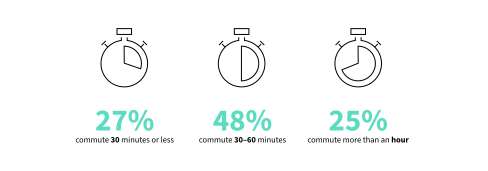
Satisfaction declines sharply as journeys lengthen: 92% of those commuting less than 15 minutes are satisfied but this drops to just 35% of employees being satisfied when their journeys exceed two hours (Figure 1).
There is also a secondary effect: employees with longer commutes tend to rate their home-working experience (H-Lmi) more positively. This may reflect more spacious living environments outside city centres, or greater investment in home setups when commuting is demanding. Either way, the implication is clear: the longer the commute, the higher the expectation is for the office experience.
Regionally, satisfaction varies widely. It is highest in Benelux and the Rest of Europe (71%), followed by the Nordics (67%), and lowest in the Americas and the UK (51%), where commute times, particularly in the UK, are often longer and less predictable.
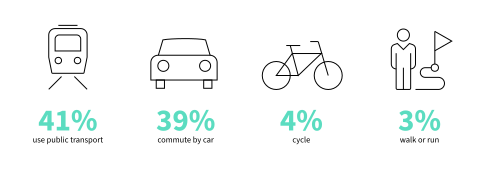
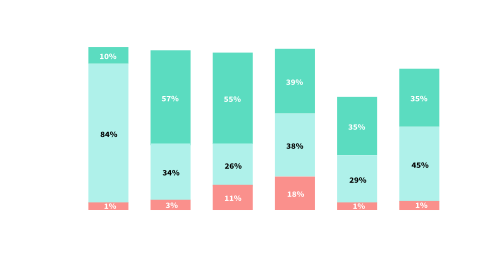
Looking more closely at regional differences reveals some clear outliers, such as the Americas, where 84% of employees commute by car, compared to Australia/New Zealand who follow at just 45%.
In the UK, 57% of employees rely on public transport, similar to Benelux and the Rest of Europe (55%). The Nordics stand out for cycling, with 18% commuting by bike.
These patterns are shaped by infrastructure, urban density, and cultural norms, and they underline why commute strategies cannot be one-size-fits-all.
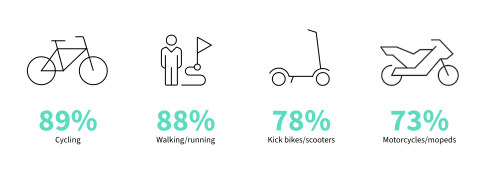
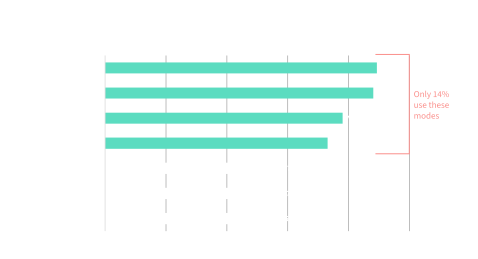
Public transport users and drivers report similar satisfaction levels (57% each). But satisfaction rises sharply for active and alternative modes:
Despite this, these highly satisfying modes account for just 14% of respondents globally, highlighting a significant gap between what people enjoy and what their circumstances allow.
Time also interacts differently with each mode of transport. Car commuters tend to remain satisfied only up to around 30 minutes, while cyclists sustain satisfaction over journeys twice as long. The difference is not just speed or efficiency but also experience.
Commute satisfaction is shaped by factors beyond organisational control, such as housing markets, public infrastructure, or geography. But employers and landlords are far from powerless.
Flexibility matters. Staggered start times reduce peak-hour stress and hybrid policies can remove unnecessary journeys without eliminating presence altogether.
Incentives can also reframe the experience. Public transport subsidies, support for carsharing, or even access to learning content can help employees reclaim commute time rather than resent it, leading to a refreshing experience at the start and end of the day.
Infrastructure for active commuting consistently pays off: secure bike storage, showers, lockers, bicycle-benefit schemes, and basic repair facilities make cycling or walking viable rather than aspirational.
Finally, location and arrival experience still count. Office sites that are well connected, and arrival environments that feel welcoming rather than transactional, can change how people feel about making the journey at all.
It is the gateway to the working day, a daily transition that shapes mood, energy, and engagement before work even begins.
When organisations treat commuting as someone else’s problem, they miss a powerful lever. When they understand and respond to the rhythms of commute, they create better experiences not just at the desk, but on the journey there.
*Leesman Commuting module, N=110,780 (Q1 2022-Q1 2025)