

Date
June 2026
Author
Dr Sepideh Yekani
Share

June 2026
Dr Sepideh Yekani


Loneliness at work is a reality familiar to many of us who spend most of our time working remotely.
As I begin writing this, I am sitting in a hotel lobby in Gothenburg, where I am based, alongside three amazing colleagues. We have just wrapped up a series of events across Sweden. In a matter of hours, they will leave, bringing to an end three days of shared work, lively discussions, knowledge exchange, the occasional bit of gossip, and, perhaps most importantly, a genuine sense of belonging.
And that is precisely the point.
Because once they leave, I return to working on my own, where I have no immediate colleagues around me.
I am, of course, grateful. Grateful to work for a company that trusts me and enables me to live and work where I choose. That autonomy is valuable, and I would not trade it lightly. Yet there is something many of us hesitate to say out loud; perhaps out of fear that acknowledging it might put that very freedom at risk.
Despite the flexibility, many of us are, at times, isolated. Social isolation is widely recognised as one of the primary challenges facing remote workers today. As the physical and often psychological distance between colleagues increases, the nature of our interactions inevitably shifts. In some cases, those interactions diminish altogether.
Hybrid working introduces another layer of complexity. Physical asynchrony has become the norm: even for those who come into the office, they may operate across varying schedules and often struggle to predict when others might meaningfully connect with colleagues, whether in person or even through digital channels.
What is lost in this shift is not insignificant.
The spontaneous conversations, the ease of asking a quick question, the passive absorption of knowledge simply by being present, even the opportunity to form genuine friendships at work, are all far more difficult to recreate in structured, pre-arranged settings. Scheduled calls and carefully planned meetings, while efficient, rarely leave room for the unplanned moments where connection and learning naturally occur.
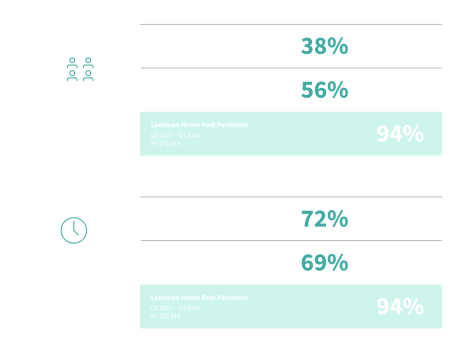
The data reflects this shift in working patterns. The proportion of respondents to the Leesman workplace experience survey who chose ‘video calls and conferences’ important for their jobs has risen markedly, from 38% in the pre-pandemic period (Q1 2018 – Q4 2019; N=387,414) to 56% in the post-pandemic (Q1 2022 – Q1 2026; N=692,190). Meanwhile, ‘planned meetings’ have remained consistently significant, selected as important by 69% of respondents both before and after the pandemic.
Yet, as the earlier reflections suggest, access to digital tools alone does not necessarily equate to meaningful connection.
The informal exchanges, the shared experiences, the small but meaningful interactions that build trust and belonging, these are not easily digitised. Yet they remain fundamental to how we work, learn, and feel connected.
This is not to suggest that remote work is inherently flawed. Far from it. Its advantages are significant and well-documented. However, in celebrating those benefits, we must be careful not to overlook the quieter downside.
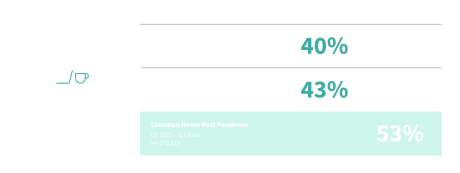
The proportion of respondents who consider ‘informal social interaction’ important has increased slightly, from 40% before the pandemic to 43% after. Encouragingly, the proportion of respondents who reported support for these interactions has also risen, from 75% to 84%.
But among home respondents, only 53% feel supported for their ‘informal social interactions’. This disparity highlights a growing tension: while the appetite for informal connection has increased, the home environment continues to fall short in facilitating it.
Yet a clear gap remains, particularly for those working from home.
In short, the desire to connect is there, but the conditions to support it are not always keeping pace.
Digital interaction is now central to working life. Yet while screens are highly effective at sustaining coordination, they are far less capable of sustaining genuine connection. Connection thrives in environments that are human: small, shared spaces, familiar rituals, accessible colleagues, and visible cues of community.
Learning through the natural rhythm of daily work, through observation, informal exchange, and simple proximity, has become increasingly valued. This is especially evident when we consider how much more effort is required to replicate these moments in a remote setting.
The small, spontaneous questions we might once have asked in passing, prompted by a glance, a shared desk, or a brief moment of eye contact, are often left unasked altogether. But aren’t these small, quick questions being quietly eliminated by distance?
These quick exchanges are not just about information, they are signals of openness, trust, and psychological safety. Without them, we may feel less supported, less visible, and ultimately more isolated.
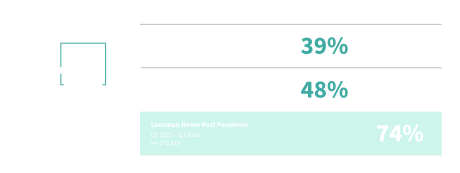
Data shows the same story. The proportion respondents who consider ‘learning from others’ important has risen from 39% before the pandemic to 48% afterwards. Support for this activity has also improved, increasing from 79% to 85% in office settings.
The picture at home, however, is less encouraging.
Only 74% of respondents think that ‘learning from others’ is supported when working from home. It shows the limitations of a fully digital environment in replicating the subtle, everyday exchanges that underpin both connection and growth.
Without frictionless, informal touchpoints, remote work can easily drift into transactional interaction. People may feel productive, but not necessarily connected and over time, that disconnect can reduce idea sharing, confidence, and emotional attachment to the organisation.
For fully remote teams, belonging does not happen by accident. It requires deliberate rituals: smaller group check-ins, peer learning sessions, informal digital spaces, and moments that are not purely agenda driven. Because when every interaction comes with a calendar invite, connection starts to feel like work and when it feels like work, it is often the first thing to disappear. The challenge, then, is not whether remote employees are engaged, but whether they feel known.
As I write these final lines, my colleagues have long since left and my working days became quiet again. This is the rhythm I have come to understand about remote work: the peaks of genuine connection, and the valleys in between. What I have learned, sometimes the hard way, is that belonging does not sustain itself, it requires tending, and that is true whether you are an individual navigating the distance, or an organisation responsible for closing it.
For organisations, this means moving beyond tools and investing in experience. Designing for connection deserves the same deliberate intent as designing for productivity — because in the long run, one cannot sustainably exist without the other.