Skip to Content

Battle of the sexes:

The gendered experience of hybrid working


People come to the office with different needs, and ideally, a workplace should be inclusive enough to support all of them so everyone can do their best work. Though, in reality, offices often fall short, with some groups experiencing more challenges than others.

Women, for instance, often carry a greater share of household and caregiving responsibilities outside of work. These additional demands, among others, can shape both the rhythm of the workday and the way employees experience their workplaces.

On the other hand, hybrid working has shifted a large share of the workforce out of the office and into the home. This raises an important question: if men and women report broadly similar experiences in the workplace, do those patterns hold once working from home and in different home working settings? In other words, do their home environments support work in the same way or do new differences emerge?

In this article, we explore how female and male employees experience work in the hybrid era, both in the office and at home, and specifically looking how working environments are distributed at home.

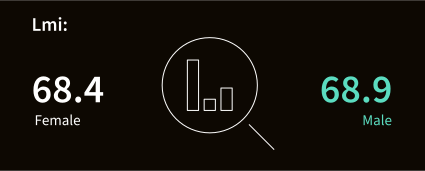
By examining post-pandemic Leesman office data, we can see that the Leesman Index workplace experience score (Lmi) suggests only a marginal difference in overall workplace experience: 68.4 for women compared with 68.9 for men.

Our data also shows that 66% of female respondents say their workplace enables them to be productive, compared to 70% of men. For nearly all other agreement statements in the survey (those relating to connection, wellbeing, pride in the workplace, etc.), the gap is only around 0–1 percentage point (pp). That makes this four-point difference on productivity stand out as a meaningful and significant gap.

The results are more varied when we turn to the Office Features that employees are asked about. There is a notion that women are more likely to be dissatisfied with the indoor environmental quality (IEQ) features, and our data shows that might especially be the case when it comes to temperature control, where the gap reaches 12 pp. It highlights how a seemingly basic feature can become a persistent source of frustration in daily work and raises the question of whether organisations are placing enough focus on creating workplaces that equally support both genders.

So, while overall office experience is largely comparable, gaps appear around the indoor environment and how well workplaces support productivity. To see if this holds beyond the office, we now turn to the home working experience.

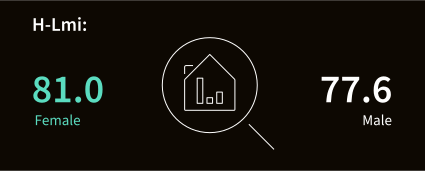
At home, however, the work experience gap widens. Women have a considerably better home working experience, with a Home Leesman Index (H-Lmi) score of 81.0, compared to 77.6 for men.

Productivity scores climb across the board, with 95% of women and 92% of men reporting that their environment enables them to work productively. But, looking beyond productivity, a pattern emerges. Across all agreement questions, activity support, and satisfaction with features, women’s scores match or exceed men’s in nearly every case.

One notable gap stands out: 78% of women working from home say they feel connected to their colleagues, compared with just 69% of men. Similarly, when it comes to their sense of connection to the organisation itself, 78% of women agree versus 72% of men (Table 2), suggesting that women may find it easier to maintain a sense of connection when working remotely than men do.

For organisations, this could raise a pressing challenge that if men feel less connected in hybrid settings, what exactly is missing from their experience? Leaders cannot ignore the imbalance, rethinking how connection is fostered may be essential if they want hybrid models to support all employees equally.

And given that women generally report higher levels of work support at home, it’s worth probing deeper: how are home working settings distributed, and could this be part of the reason behind their greater satisfaction?

So, who actually gets a dedicated workspace at home?

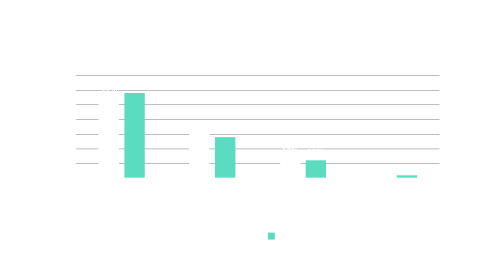
Our data shows that the type of setting used at home is a strong driver of the overall experience. Those with a dedicated room consistently report the highest experience scores, a pattern also reflected in our post-pandemic Home survey results. In our data, 57% of respondents have a dedicated work room or office (H-Lmi = 82.2), 30% work in a dedicated work area within a shared space (H-Lmi = 78.7), and the remaining 13% work from non-work areas or other locations at home (H-Lmi = 70.1).

Interestingly, a small gap emerges when viewed through a gender lens: 58% of men report having a dedicated work room or office at home, compared with 55% of women (a 3 pp difference) (Figure 1).

Since 2020, when we began collecting Leesman Home data during the pandemic, the proportion of employees with a dedicated work room or home office has increased. This suggests that more employees have been investing in creating dedicated work settings at home.

However, when looking at the proportion of women having ‘a dedicated work room or office at home’ versus men historically, we see a bigger gap. But that gap has also shifted: from 38% of women compared to 44% of men in 2020, to 57% versus 60% in 2024 (Figure 2).

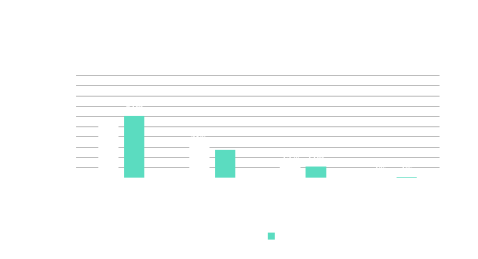
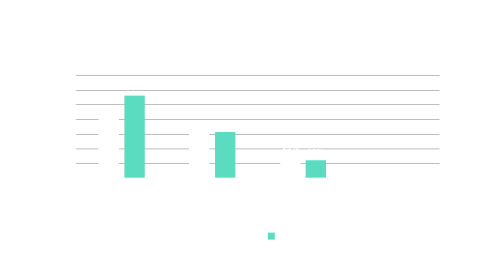
It is also interesting to see how work settings distribution shifts when someone else is at home. Our post-pandemic Leesman Home data shows that when ‘a partner or family members’ are present, women are less likely to have a dedicated work room: 56% of women compared with 61% of men. However, this gap widens further to 9 pp, when ‘one or more children or dependents’ are at home, again in favour of men (see Figure 3 and Figure 4). This suggests that caregiving contexts don’t just amplify inequalities in access to dedicated workspace, they entrench them, reinforcing traditional gender dynamics.

And yet, women still report higher satisfaction and stronger support when working from home. That paradox may help explain why hybrid models resonate so strongly with women: even when the playing field at home isn’t entirely level, the home environment still outperforms the office in meeting their needs.

Conclusion

It’s clear that hybrid working is not a uniform experience. Women consistently report higher levels of support and satisfaction at home, where productivity and connection to both colleagues and organisation appear stronger than for men. In contrast, the office reveals gaps, particularly around indoor environmental quality; factors that women value more but are less satisfied with.

At the same time, the home is not free of inequities. Men are still more likely to claim dedicated work rooms, with the gap widening in households with partners or children. Yet despite this imbalance, women report higher satisfaction across nearly every dimension of home working, suggesting that the appeal of hybrid working for women lies not only in the physical setup but also in other factors, such as autonomy, flexibility, and balance, which may matter even more. For organisations, the challenge is clear: to design hybrid strategies that address both the cultural and physical barriers still shaping how men and women experience work.

Footnote:

Our post-pandemic Leesman Office data (n=579,460, Q1 2022 – Q2 2025) includes 31% female (n=181,545) and 35% male (n=205,735) respondents. There are, of course, other gender identities represented in the data (n=995), as well as respondents who preferred not to disclose their gender (n=13,419).

The post-pandemic Leesman Home data (n=286,940, Q1 2022 – Q2 2025) shows a similar distribution: 31% of respondents identified as female (n = 90,271) and 35% as male (n = 100,737). Other gender identities are also represented (n = 472), along with respondents who preferred not to disclose (n = 6,558). For the purpose of this article, we use terms such as women and female interchangeably, while acknowledging that gender identity is more nuanced than binary categories.

It is also important to note that our sample sizes for non-binary and other gender identities are currently too small to allow meaningful analysis. We hope to explore these perspectives more fully in future studies as our dataset grows.