

Date
December 2025
Author
Eryn Lalonde
Share

December 2025
Eryn Lalonde


The modern workplace is shaped by a constellation of physical features that together influence how people feel, how they work and how they perceive the value of the spaces they occupy.
As organisations navigate hybrid working, rethink their portfolios and attempt to create environments that justify the commute, it is increasingly clear that no single feature determines workplace success.
Instead, the overall experience is created through the interplay of light, temperature, noise, furniture, technology, cleanliness, indoor environmental quality and more. Air quality has become a meaningful part of this conversation, not because it is the most important feature, but because it illustrates how environmental fundamentals shape day-to-day experience in ways that employees immediately feel.
Across the Leesman global benchmark*, 66% of employees consider air quality important, yet only 52% are satisfied with it in their workplace. This pattern mirrors gaps seen across other indoor environmental quality features, where expectations for temperature, noise levels or lighting often exceed what workplaces are currently delivering.
Indoor environment features important to more than 50% of employees
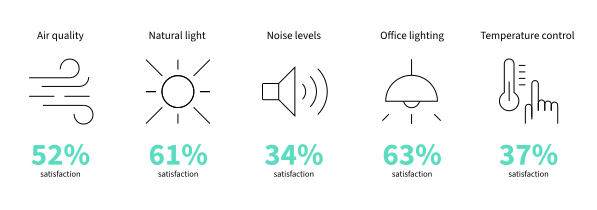
In Leesman+ buildings, those that have achieved certification for their high-performance workplaces, air quality satisfaction looks notably stronger (70%). This alignment is characteristic of these high-performing environments. It reflects the strength of workplaces that consistently and successfully provide a broad range of features, resulting in higher overall satisfaction and stronger wellbeing outcomes.
Similar findings appear in the wellbeing data. In the average workplace, only 67% of employees agree that their environment positively impacts their overall wellbeing. In Leesman+ buildings, this figure rises to 81%. Air quality may contribute to this uplift, but it’s alongside ergonomics, spatial variety, cleanliness, technology, and other essential physical and service features.
Although air quality is just one item within a larger framework, it exemplifies how physical conditions influence workplace performance, comfort and overall employee experience. People respond instinctively to indoor environmental quality, even when they cannot pinpoint the source of distraction or discomfort. When the air feels stuffy or circulation is poor, energy levels could dip and focus weakens. When conditions are stable and fresh, people could likely feel more alert, more engaged and better supported.
This dynamic mirrors what is seen across other physical features: lighting can affect the circadian rhythm and comfort, acoustics can influence concentration, temperature impacts physical ease and furniture can play a part in posture and fatigue.

The growing emphasis on indoor environmental quality has also been reinforced by global benchmarks and certification frameworks. Standards such as WELL, LEED and BREEAM have brought greater attention to the conditions that underpin health, wellbeing and performance in buildings.
Notably, Leesman is a pre-approved survey provider for the WELL Building Standard, meaning that its methodology meets WELL’s rigorous requirements for capturing employee experience. This connection illustrates a broader industry shift: employee feedback is now recognised as an essential component of building performance. WELL’s approach highlights that a workplace cannot claim to support wellbeing solely on technical specifications; it must also demonstrate that employees feel those conditions are working for them.
For leaders, the key takeaway is that workplace improvements require a broad, evidence-based approach. It is no longer effective to rely on assumptions about what employees value or to invest in popular trends without understanding their impact. Workplace performance varies building by building, floor by floor and team by team. Some environments may need improvements in ventilation, while others struggle more with acoustics or technology.
Only robust data, gathered systematically and consistently, reveals which features are underperforming and where investment will drive meaningful improvement. A data-driven approach provides organisations with a way to measure the lived experience of the workplace in a structured, comparative and credible way.
The organisations that perform best are those that view these features as interdependent components of a larger system. Improvements in air quality, for example, can be pursued in tandem with sustainability goals, wellness certifications and broader environmental upgrades. The goal is not to perfect a single feature but to strengthen the workplace ecosystem as a whole.
*Q4 2015 – Q3 2025, N=1,395,143