Skip to Content

Where workplace performance sits

Hybrid working has prompted organisations to re-evaluate how office environments can best support employee engagement and productivity.

Much of the investment narrative spotlights collaboration hubs, social spaces, and wellness amenities. Yet one of the most basic drivers of daily performance is the office chair.

According to our Leesman workplace experience data *, the ‘chair’ consistently ranks among the top three most important physical features, alongside the ‘desk’ and ‘monitor’.

83% of employees consider it critical, but only 69% are satisfied with the one they use. Even in Leesman+ certified workplaces (those that meet specific criteria to rank among the world’s high performing workplaces), satisfaction reaches just 77%.
Even in the world’s leading workplaces, nearly a quarter of employees are still dissatisfied with one of the most basic tools that they rely on every day.

Chair satisfaction may sound trivial, but it isn’t. It is shaped by more than just comfort, like material, softness, size, and aesthetics. Design and ergonomics matter deeply, from adjustability and flexibility to whether chairs can be moved easily in meeting rooms to support fluid discussions. Yet too often, these basics are overlooked.

In settings where employees spend most of their day at a desk, adjusting work settings like seat height, backrest angle, lumbar support, and armrest positioning becomes critical. The ability to personalise one’s workstation can also influence satisfaction with chairs: while 48% of employees consider it important, only 44% are satisfied with what is available.

The challenge is often greater in unassigned workplaces, where each change of setting requires another round of adjustments. Some employees simply skip the process, trading posture and comfort for time and convenience. Others may need additional ergonomic support, like extra cushions or backrests and carrying these aids in every day can quickly become a hassle.

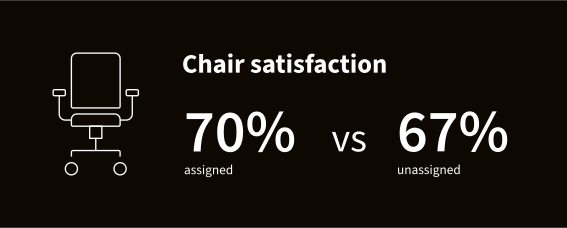
In some offices, ergonomic chairs are in short supply and allocated on a first-come, first-serve basis, leaving some employees in seats never designed for long-term use. While the gap in chair satisfaction between assigned and unassigned workplaces appears small, 70% versus 67%, these averages may mask wide variations and could be far larger for certain groups or minorities.

Unassigned workplaces, if designed around real needs, can still offer a meaningful trade-off: greater diversity, choice, and equality in access to chairs and workstations.

The significance of the office chair extends well beyond looks. It is the foundation of daily working life. And in hybrid models, where the office must constantly prove its value, that foundation matters more than ever.

The humble chair can fuel engagement, performance, and even a sense of ownership over the workplace; or it can undermine them all when it fails to support its users.

Too often, organisations chase the spectacular; wellness hubs, creative lounges, innovation labs, while overlooking the essentials.

But neglecting the basics can quietly undermine even the most cutting-edge environments.

Chairs don’t make headlines, but they shape the daily reality of every employee. And if the seat is wrong, the whole experience tilts; proof that no workplace can afford to overlook the basics. Because when the fundamentals fail, everything else follows.

*Leesman Office Survey, N=1,380,814 (Q2 2015 – Q2 2025)